Everyone says they use AI. Almost nobody can say where they sit. This is the scale I use to place a business before spending a dollar on it, from the automation floor at zero to fully autonomous at seven.
Usage is not position. Using AI every day does not move you up this scale. What moves you up is a change in who starts the work.

I run a four-person agency on sixteen AI agents with a board above them, and every dollar those agents cost lands on a client’s job card. This is the scale I place a business on before I quote it.
Follow on LinkedInIf every AI interaction in your business starts with a person typing, you are at level two.
Every AI maturity model, this one included, grades how much your AI can do on its own. That is the race the whole market is running, and it is the wrong question for a business with staff, clients and something to lose.
Autonomy without accountability is not progress. It is exposure. The question that decides whether you can actually run on this is a different one: can you answer for what it did? Who asked for it, who approved it, what it cost, and what happens when it is wrong.
So there are two ladders here, not one. The first is crowded. The second is nearly empty, and it is the one your accountant, your insurer and your clients will ask about.
Eight rungs, from the automation floor to fully autonomous. This is the axis everyone measures.
Rules, templates, and things that file themselves. This is not AI, and it is not optional. Until the plumbing is in, there is nothing for anything else to stand on.
A window in another tab. Prompt, copy, paste, check. The work happens outside your systems and nothing is retained. This is where almost everyone starts, including me.
It knows your brand and your numbers. The output is genuinely better. But every single interaction still begins with a person deciding to type something.
It has a job, not a prompt. It does the whole task end to end and comes back with it finished, for a person to approve. This is the first rung where your hours actually change.
Standing responsibilities. It notices without being asked, works while you sleep, and comes to you first with what it found. You manage it rather than operate it.
Roles, work handed between agents, one handbook they all follow, and a board above the lot holding the AI manager to account for what it said it would do. This is the rung where it stops being a tool and becomes infrastructure.
It reads last month and changes what it does next, with the board approving the change. Not a model retraining itself, a business changing its own behaviour on evidence.
Runs a whole function, sets its own goals, nobody in the loop. It is not real yet, and I would argue it is not a goal worth aiming at. Level seven means nobody is accountable when it is wrong. In a business with clients and staff, that is not an achievement, it is an exposure.
Autonomy is what it can do without you. Accountability is what survives the question “who approved this, and what did it cost?” You need a rung on both. A business high on one and low on the other is not advanced, it is uninsured.
Work happens in someone's browser tab. No record of what was asked, what came back, or what it cost. If a client queries it in six months, you have nothing.
You can see after the fact what the AI did. A transcript exists. Nobody reads it, but it exists.
Every piece of work is tied to a person who asked, a client it was for, and a job it belongs to. This only becomes necessary once the whole team can hand work to the agents rather than one operator running them privately.
You know what each piece of work cost in AI spend, and it lands on the job card beside the human hours. Not a monthly platform bill you divide by guesswork. Per task, per client, against a cap you set.
Nothing leaves the building without a named person signing it off. The approval is recorded against the work, so there is always an answer to “who let this go out?”
Standing responsibilities, a recurring meeting where the agents report against what they committed to last time, and a board above the AI manager holding it to its own word. The rhythm a real company runs on, applied to the part of the company that is not human.
Ladder one is a capability race, and a well-funded lab will always win it. Ladder two is an operating problem, and only someone actually running a business with clients and money ever solves it.
Professional services run on one piece of software: the PSA. It holds your jobs, your budgets, your people’s time, and the margin you actually made. Every PSA on the market tracks what your people cost against a job.
Not one of them tracks what your AI costs against the same job.
While AI was a side tool, that did not matter. But the moment agents do a real share of delivery, half your cost of delivery is sitting outside the system that calculates your margin — showing up as a flat subscription in overheads, spread across every client equally, attributable to none of them. You will still get a margin number. It will just be wrong, and nothing you own will tell you.
Agents and humans on the same job card, costed live.
An agent finishes a task and its cost lands on that client’s job, that day, next to the hours a person booked. One ledger, one margin, both kinds of worker. It runs on our own operation, on real client work, right now — which is the only reason we are willing to say it out loud.
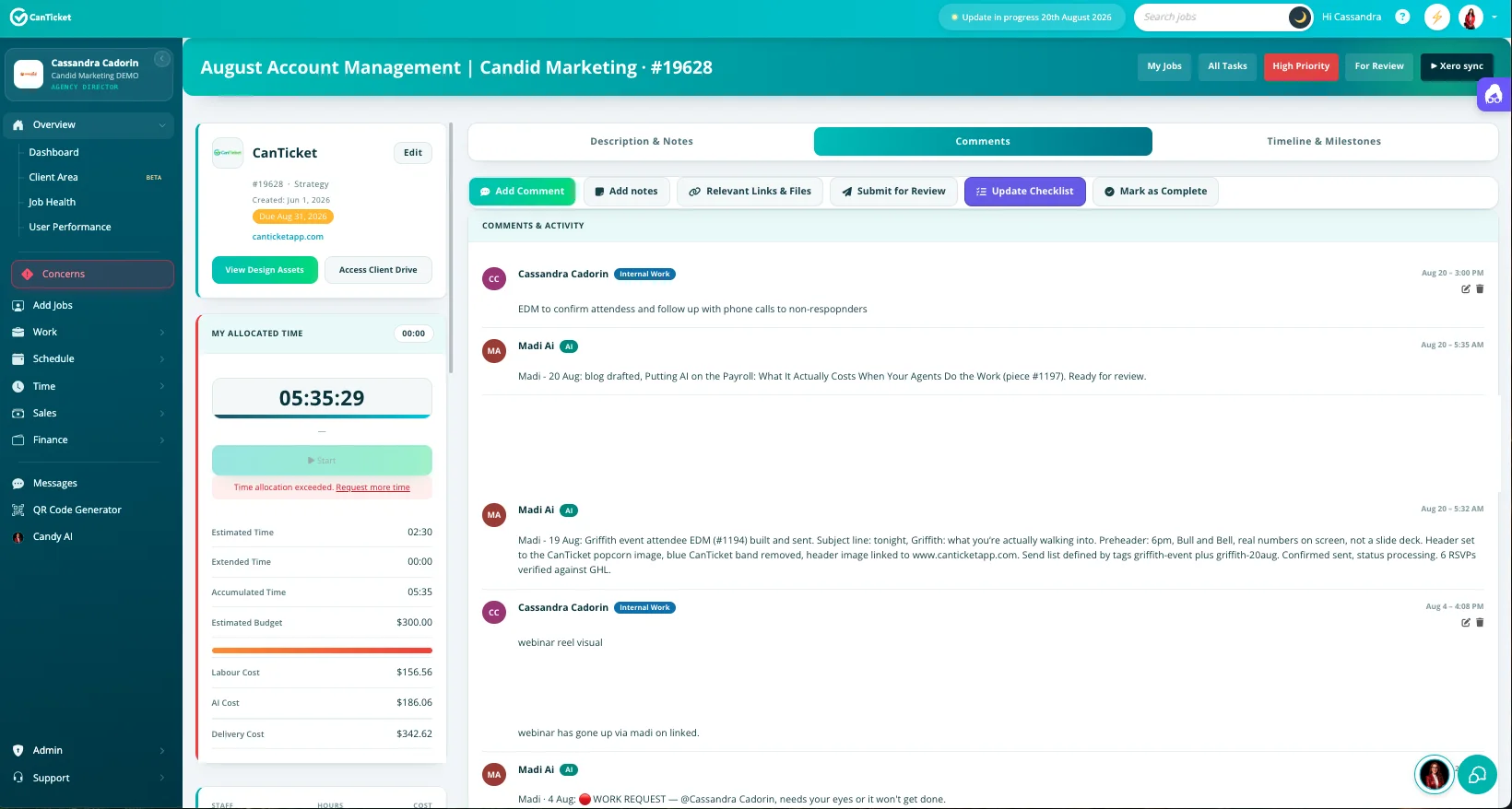
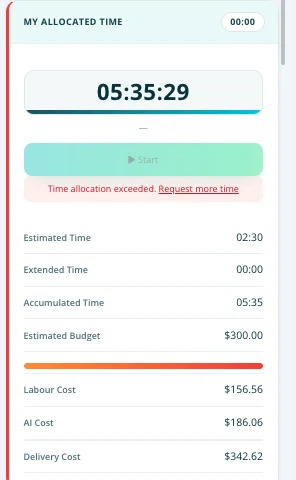
Budget was $300.00. The people cost $156.56. The AI cost $186.06. Delivery came in at $342.62.
Two things worth sitting with. The AI cost more than the humans did. And the job went over budget by $42.62 — which no PSA on the market would have shown you, because the larger half of that cost was never on the job in the first place.
This is our own account management job, not a client’s. We are not going to prove a point with someone else’s numbers.
This does not require you to run our agents. If you already have an AI stack, the ledger still works. The point is not whose agents they are, it is that somebody is finally counting them against the job.
Australian Bureau of Statistics, Business Characteristics Survey 2024-25. Around 7,000 businesses, collected October 2025 to February 2026.
Leaning in is the only variable you control.
I run a four-person agency on sixteen AI agents with an AI board above them. Forty-five minutes, free, online, no slides. You will see the whole thing working, and every dollar of AI cost landing on a real client's job card.
 CanTicket