
AI tech with global traction, built on home soil.
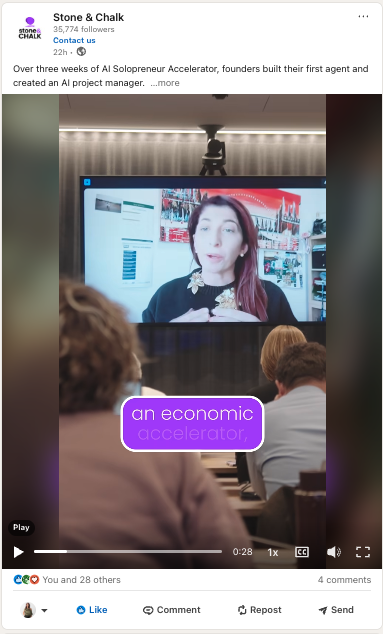
I have been running this workshop with Stone & Chalk in Adelaide, Brisbane and Sydney. Auckland came separately, off the back of being visible online, and I am speaking at the Small Business & Franchise Show there in September.
I will demonstrate two things I have built. CanTicket, the software my business runs on, and the Command Centre, where sixteen AI agents do the work of a much larger team. Live, in a town where finding good staff is the hardest part of growing anything.
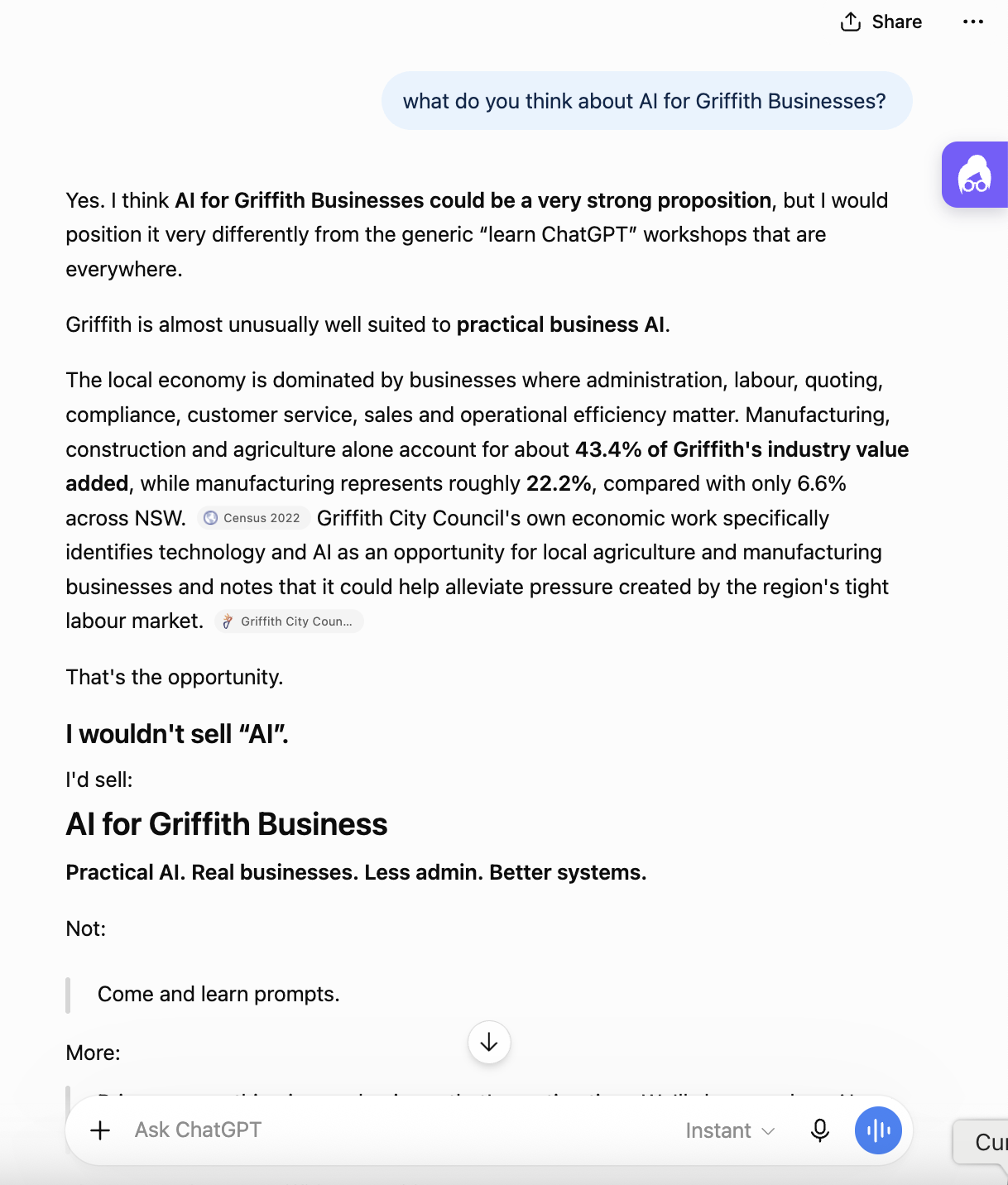
Places like ours do not get left behind if we move first. Like Griffith.
 Auckland · September

You train someone for two years. They get head-hunted the week you finally book a holiday.
And you are back at ground zero. Again. Out here it is hard enough to hire in the first place.
The knowledge was never in the business. It was in their head, and it left with them.
Ten years in, I worked out I had built a business that ran on SOPs and hope. That people read them, and that the things I could not see were getting done.
Not by choice.
You invoiced 214 of 312 hours.
The gap is admin and redo. It does not show up on an invoice, it shows up as a worse year. Most operators have never seen it laid out, because nothing they own is counting it.


Software that finds the leak while it’s happening.

 Xero connected
JM
Xero connected
JM

What people think AI is, and what it actually is.
Tap a side. I will talk you through it.

Connect




What counts as AI, and what does not.
Three different things get called AI in the same sentence. They are not the same, and two of them are steps you have to take before the third one works.
Out of the box, AI is confidently mediocre.
Quick with the average answer. Blind to what actually works in your niche. Happy to pad a thin brief with filler and hand it back like it is finished. That is the part you cannot prompt your way out of, and it is the whole reason she exists.
She is allowed to disagree with the owner when the evidence, the strategy or the principles say she should. Most people are surrounded by staff who will not do that. Most AI is built so it cannot.

An AI org chart, not a chatbot.
Everything sits inside your guardrails. Except you.
Skills are assigned per agent, not overlapped.
Just like humans, nobody owns everything — and she does not decide alone.
What an AI team of specialists looks like, outside the org chart.
Talk to them like staff. She keeps them in line.
The Seven Levels of AI Maturity
Everyone says they use AI. Nobody can say where they sit. Find your rung before you spend a dollar.
Usage is not position.
With five staff it is a tool. With thirty it is an exposure.
Every person you hire is a new door. Three of them, and none are locked.
Incidents involving unapproved AI tools more than doubled in 2026, to 43% of organisations, at an average cost of US$5.39 million. It is happening every day, in conversations you cannot see, and nobody is logging any of it.
The big end of town is pulling away.
It only works if it can see the business.
This is the part that separates it from a chat window: it is connected to the things that already tell you how you are going. Your analytics and search console, your CRM, your socials, your ads, your email, your calendar, your accounting, and your sites and servers. One technical contact authorises your own tools. Nothing is scraped and nothing is guessed.
Labour, AI and delivery cost, against the estimate, while the work is still running. So you can answer the question every services business will be asked within a year: what does it actually cost us to serve this client now.
This one does not exist anywhere else.
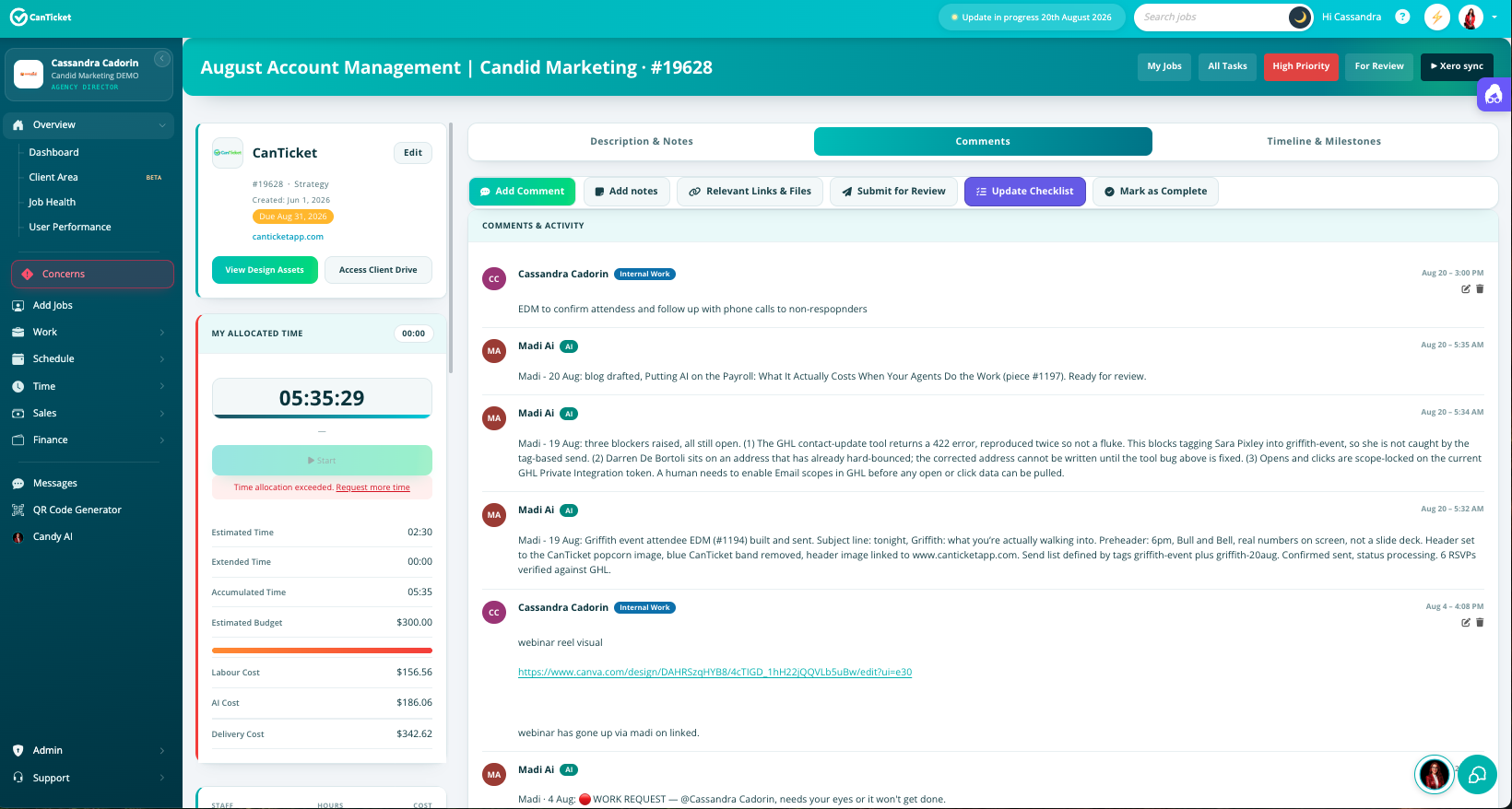
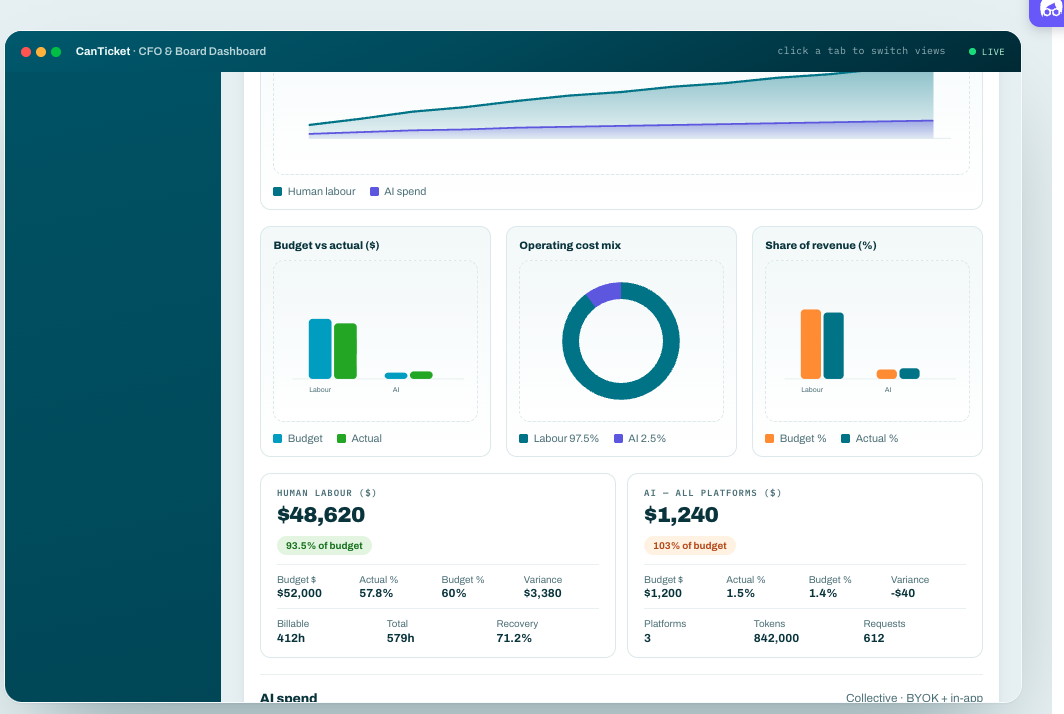
Human labour and AI spend as one line item, live, not a PDF invoice that arrives with no attribution. Budget vs actual, operating cost mix, share of revenue.
Depending on whether you have people.
Your people stop drowning in tabs. The AI watches the numbers, tells them what moved and what to do next, and clears the grunt work off their desks. Their hours go to strategy and to clients, and the new starter walks into a business that already knows how it works.
A whole department without hiring one. It watches your numbers, writes and schedules the content, runs the email and the ads, and tells you what actually matters this week. You get back to the business.
Outcomes, not a licence to another dashboard.
Your IP never leaves your fence.
Before anyone builds anything: the question everybody should ask, and almost nobody does.
Your data, your brand, your contacts, your client history, and every result it produces. It never becomes House of Can's to keep, sell, or train on.
The software and the agent framework itself. It runs on our infrastructure, not yours, and is never handed over, copied, resold or reverse-engineered.
What is still human.
This is a build, not a switch you flip.

Hi, I'm Cass.
Between a marketing agency and a software company, there were too many things to manage and too many tools that did not talk to each other. The idea was to run everything from two places instead of twenty: the Command Centre for the AI team, and CanTicket where people and AI work the same tickets. Less busywork, nothing falling through the cracks.
I did not build this and then start using it. I used it to build it. Every decision about where this company is going has been argued out with the board and with my AI MD. Hours of it. They pushed back, I changed my mind, and what is described on this page is what came out the other side.
So this is not another dashboard to babysit. It is a small AI team that does the real work, with you steering.
Ready for more? Let’s have a proper chat.
It would fall straight through. There is nothing in the business yet to hold it. Selling sand to a sieve.
The whole talk on one page: where the margin leaks, the seven levels, what is still human, and what to do next. Made to forward to whoever else has to agree.
Get the takeaway →